
The second floor of this Melrose home overheated throughout the winter while the first floor rarely became comfortable.
Changing the thermostat did not solve the problem because the imbalance was built into the original gravity hot water system.
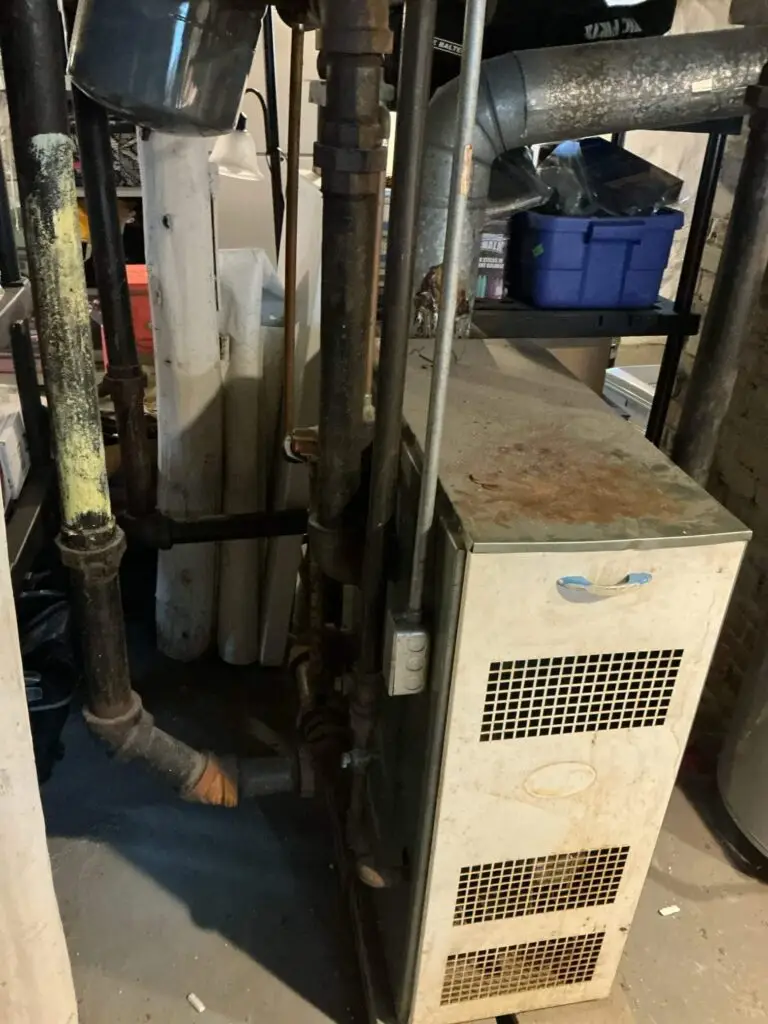
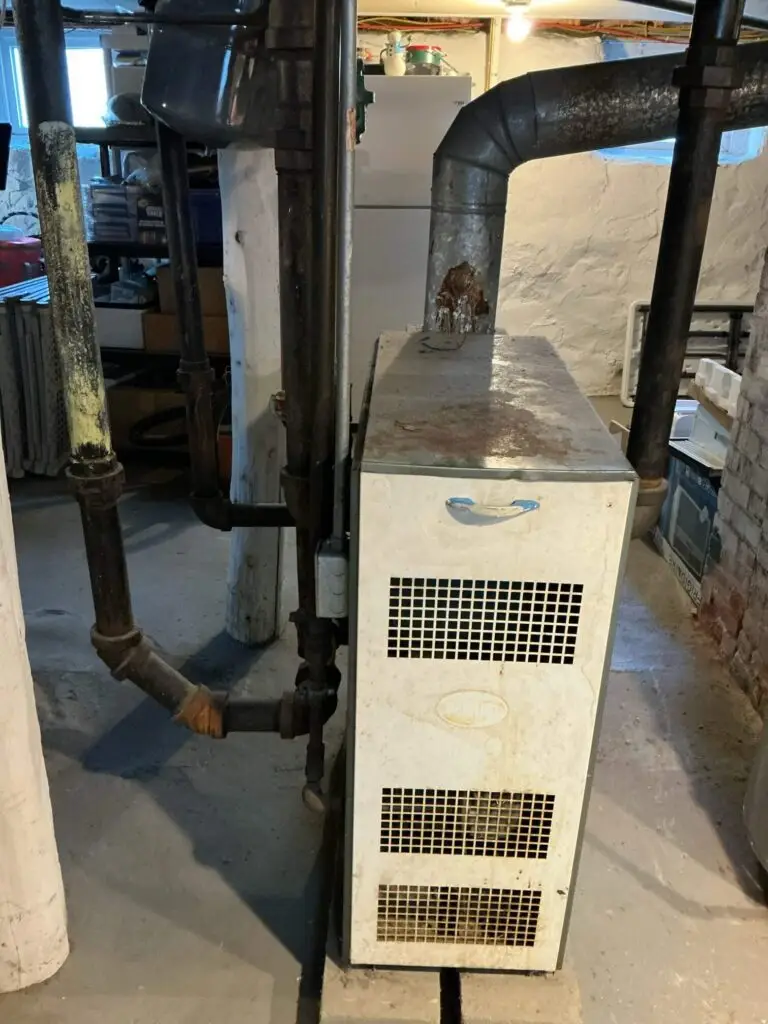
Gravity hot water systems do not use a modern circulator pump. Instead, heated water rises from the boiler through large pipes to cast iron radiators. As the water cools, it naturally falls back toward the boiler.
Because hot water rises, these systems can deliver more heat to upper floors than lower ones. In this home, that meant excessive heat upstairs and insufficient heat downstairs.
Installing a new boiler on the existing piping would have replaced the equipment without correcting the underlying distribution problem.
Pespisa began with a Manual J load calculation and redesigned the property around two independent comfort systems. Mitsubishi Hyper-Heat heat pumps now serve the second floor, while a compact Navien boiler supplies the first-floor radiators through entirely new piping.
A stainless steel indirect water heater was added during a later phase to complete the mechanical system.
Project at a Glance
| Project detail | Information |
|---|---|
| Location | Melrose, Massachusetts |
| Primary problem | Second floor overheating while the first floor remained cold |
| Previous system | Gravity hot water heating with an ageing boiler and no air conditioning |
| Design approach | Manual J load calculation and split-system redesign |
| Second-floor system | Mitsubishi Hyper-Heat ductless heat pumps |
| First-floor system | Navien condensing boiler and Mitsubishi heat pump |
| Hydronic work | Removal of old basement piping and complete first-floor repipe |
| Domestic hot water | Custom Comfort 4Pro stainless steel indirect water heater |
| Project period | December 2025 through July 2026 |
| Project phases | Heat pump and boiler installation, hydronic repipe and indirect water heater installation |
The Problem With the Original Gravity Heating System
The home’s comfort problem was caused by the way the original heating system distributed hot water.
The gravity system created several challenges:
- Hot water naturally travelled toward the upper floor, causing the second floor to overheat.
- The first-floor radiators did not receive enough consistent heat.
- The entire home operated as one heating loop with one temperature setting.
- There was no independent room or floor-level control.
- The ageing boiler continued using fuel even when the upstairs rooms were already too warm.
- The home did not have air conditioning.
- The existing water heater was approaching the end of its service life.
The thermostat could tell the boiler when to run, but it could not control where the hot water travelled.
Why a Boiler Replacement Alone Would Not Work
A straightforward boiler replacement would have been the easier proposal, but it would not have solved the homeowner’s main complaint.
The old oversized gravity piping would still have favoured the second floor. The new boiler would have continued sending heat through the same unbalanced distribution system.
The homeowner may have received newer, more efficient equipment, but the first floor could have remained cold while the second floor continued overheating.
The system therefore needed more than an equipment replacement. It needed a full comfort redesign.
Pespisa removed the second floor from the hydronic heating loop and assigned each part of the home to equipment sized for its actual heating and cooling requirements.
The Hybrid Heating and Cooling Solution
After completing a Manual J load calculation, Pespisa divided the home into independent systems.
The second floor moved entirely to ductless heat pumps. The existing first-floor radiators remained in use, but they were connected to a smaller Navien boiler through new hydronic piping.
The result was a hybrid heat pump and boiler system designed around the layout and heating load of the property.
Mitsubishi Hyper-Heat Systems for the Second Floor
Mitsubishi Hyper-Heat heat pumps became the only source of heat for the second floor.
The upstairs system included:
- One Mitsubishi MXZ-3D24NLHZ Hyper-Heat outdoor unit
- Two-ton capacity
- 20 SEER2 efficiency rating
- 10 HSPF2 heating efficiency rating
- Three Mitsubishi MSZ-GX06NL ductless indoor units
- One indoor unit in each bedroom
- Built-in Wi-Fi control
- Wireless temperature sensors for each indoor unit
Each bedroom can now maintain its own temperature.
The wireless sensors measure the temperature within the occupied area of the room rather than relying only on the temperature near the indoor unit. This gives the system more accurate information and improves room-level comfort.
The Mitsubishi system also introduced cooling to the upstairs bedrooms.
First-Floor Heating and Cooling
The first floor received a separate Mitsubishi system for cooling and supplemental heat.
The system included:
- One Mitsubishi MUZ-GX12NLHZ outdoor unit
- One-ton capacity
- One Mitsubishi MSZ-GX12NL indoor unit in the living room
- ecobee smart thermostat integration
The first-floor Mitsubishi unit provides cooling for the primary living area and can supplement the radiator system when needed.
Navien Boiler and New Piping for the First Floor
With the second floor removed from the hydronic load, the first-floor radiators required a much smaller boiler.
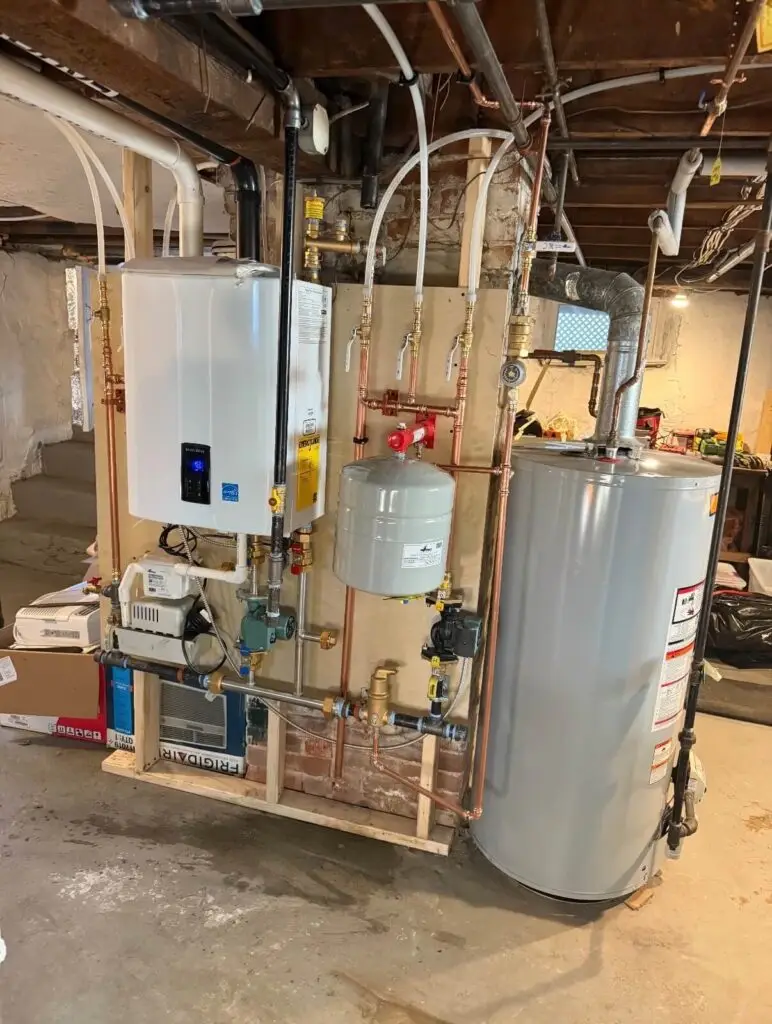
Pespisa installed a Navien NHB-55H condensing boiler with:
- 55,000 BTU capacity
- 95% AFUE efficiency rating
- Wall-mounted installation
- Outdoor reset control
- Direct sidewall venting
- UL 1738 venting materials
The outdoor reset sensor allows the boiler to adjust its water temperature based on outdoor conditions.
During milder weather, the boiler can operate at a lower water temperature. During colder conditions, it can increase the temperature supplied to the radiators.
This helps the boiler operate for longer, steadier cycles and spend more time within its efficient condensing range.
The wall-mounted installation also freed up basement floor space compared with the equipment it replaced.
Complete Hydronic Heating System Repipe
Pespisa removed the old gravity piping from the basement and rebuilt the first-floor radiator loop.
The new hydronic system included:
- New supply and return piping
- Taco 007E ECM circulator
- Spirovent air separator
- New expansion tank
- Caleffi fill valve
- Backflow preventer
- Outdoor reset sensor
- New isolation and service valves
- Direct sidewall venting
Removing the old piping addressed the source of the original heating imbalance instead of attempting to compensate for it with a larger boiler or higher thermostat setting.
Stainless Steel Indirect Water Heater
The domestic hot water system was completed during a later project phase.
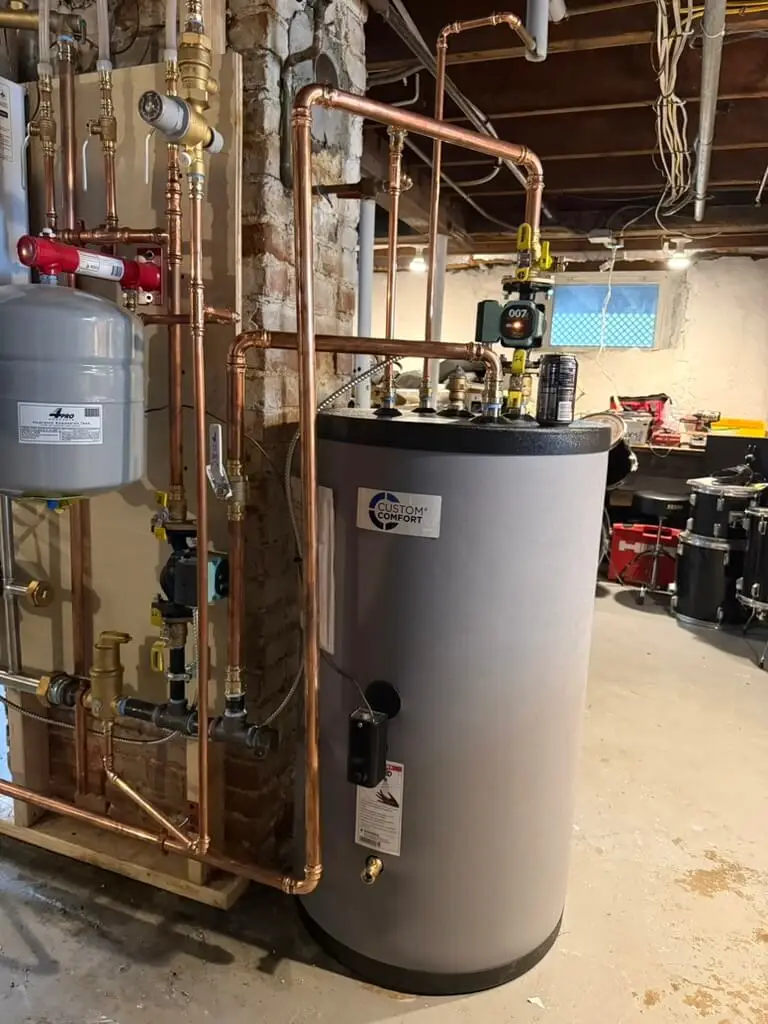
Pespisa installed a Custom Comfort 4Pro 40-gallon stainless steel indirect water heater.
The installation included:
- Stainless steel indirect tank
- 40-gallon storage capacity
- Lifetime tank warranty
- New supply and return heating lines from the boiler
- New hot and cold domestic water piping
- New temperature and pressure relief valve
- New vacuum relief valve
An indirect water heater uses the boiler to heat domestic water. It does not require a separate burner or dedicated exhaust vent.
This allowed the homeowner to use the high-efficiency boiler for both first-floor heating and domestic hot water.
Why This Design Was Right for the Home
The split design addressed the cause of the comfort problem rather than simply replacing ageing equipment.
It removed the source of the imbalance
The second floor no longer depends on hot water travelling through the gravity piping.
Each upstairs room is now served by a ductless heat pump with its own temperature control.
It allowed the boiler to be properly sized
Once the second floor was removed from the hydronic system, the first-floor radiator load required only a 55,000 BTU boiler.
Using a smaller, right-sized boiler helps reduce short cycling and supports longer, more efficient operating periods.
It added room-by-room temperature control
Each upstairs bedroom received its own indoor unit and wireless sensor.
The rooms that previously overheated can now maintain individual temperature settings.
It introduced air conditioning
The new Mitsubishi systems provide air conditioning in the upstairs bedrooms and the primary first-floor living area.
The home previously had no mechanical cooling system.
It modernised the domestic hot water system
The indirect water heater uses the Navien boiler as its heat source and does not require a separate burner.
Its stainless steel tank also includes a lifetime tank warranty.
It reduced the mechanical system’s footprint
The wall-mounted boiler and organised piping created a more compact mechanical area than the equipment and gravity piping they replaced.
Results of the Gravity Hot Water Conversion
The family now has separate systems serving the different comfort needs of each floor.
The completed project delivered:
- More balanced heating between the first and second floors
- Independent temperature control in each upstairs bedroom
- A dedicated radiator system for the first floor
- A 95% AFUE Navien condensing boiler
- Weather-responsive boiler operation through outdoor reset
- New hydronic piping for the first-floor radiators
- Cooling in the bedrooms and primary first-floor living area
- Smartphone control for the Mitsubishi indoor units
- ecobee thermostat integration
- High-efficiency domestic hot water
- A stainless steel indirect water heater with a lifetime tank warranty
- A cleaner and more compact basement mechanical area
Equipment Installed
| Category | Equipment and work completed |
|---|---|
| Location | Melrose, Massachusetts |
| Project type | Gravity hot water conversion and full comfort-system redesign |
| Previous system | Gravity hot water heating with ageing boiler and no air conditioning |
| Design basis | Manual J load calculation |
| Upstairs heat pump | Mitsubishi MXZ-3D24NLHZ Hyper-Heat, two tons |
| First-floor heat pump | Mitsubishi MUZ-GX12NLHZ, one ton |
| Indoor units | One MSZ-GX12NL in the living room and three MSZ-GX06NL units in the bedrooms |
| Boiler | Navien NHB-55H condensing boiler, 95% AFUE and 55,000 BTU |
| Hydronic system | Complete basement repipe, Taco 007E ECM circulator, Spirovent and outdoor reset |
| Water heater | Custom Comfort 4Pro 40-gallon stainless steel indirect tank |
| Controls | Mitsubishi Comfort app, wireless room sensors and ecobee smart thermostat |
| Venting | UL 1738 direct sidewall venting |
| Completed | December 2025 through July 2026 |
| Project phases | Three |
Before and After the Melrose Gravity Heating Conversion
Available Incentives for This Melrose Project
Based on the equipment selected and the project requirements, this installation was identified as potentially eligible for:
- $3,537.50 in Mass Save heat pump rebates
- A $2,600 federal tax credit
- 0% Mass Save HEAT Loan financing of up to $25,000
Pespisa completes the system sizing and load-calculation documentation required for many incentive programmes and can help homeowners understand the application process.
Rebates, tax credits and financing are subject to programme requirements, property eligibility, equipment eligibility and final approval.
Frequently Asked Questions
Why did the second floor overheat with a gravity hot water system?
Gravity hot water systems rely on natural circulation rather than a modern circulator pump. Because heated water rises, upper-floor radiators can receive more heat than lower-floor radiators.
In this Melrose home, the piping arrangement caused the second floor to overheat while the first floor struggled to reach a comfortable temperature.
Can a gravity hot water system be converted to a modern boiler?
Yes, but the correct approach depends on the condition and design of the existing piping.
A boiler replacement alone may not solve uneven heating when the imbalance is caused by the original gravity piping. A load calculation and system evaluation should be completed before selecting new equipment.
Can heat pumps and radiators be used in the same home?
Yes. A hybrid system can use heat pumps in selected rooms or floors while retaining hydronic radiators in other parts of the home.
For this project, heat pumps served the second floor while a Navien boiler supplied the first-floor radiators.
Why was the old gravity piping removed?
The oversized basement piping was part of the original heating imbalance.
Removing it allowed Pespisa to rebuild the first-floor radiator loop with modern piping, a circulator pump and improved system controls.
What is an indirect water heater?
An indirect water heater uses a boiler to heat domestic hot water through a heat-exchange coil inside the storage tank.
It does not have its own burner and does not require separate combustion venting.
What does an outdoor reset control do?
An outdoor reset control adjusts the boiler’s water temperature according to the outdoor temperature.
The boiler can use cooler water during milder weather and increase the water temperature as outdoor conditions become colder.
Can this type of project qualify for Mass Save incentives?
Heat pumps and other efficiency improvements may qualify for Mass Save incentives when the property, equipment and installation meet programme requirements.
Eligibility and incentive amounts should be confirmed before work begins. Approval is not guaranteed.
Does Your Home Heat Unevenly?
When one floor overheats while another stays cold, the problem may be the original system design rather than the thermostat.
Pespisa evaluates the home’s heating load, piping, radiators, insulation and comfort needs before recommending equipment.
Depending on the property, the right solution may involve a modern boiler, ductless heat pumps, new hydronic piping or a combination of systems.