
HVAC and Plumbing Planning for ADUs in Massachusetts

Planning an ADU in Massachusetts means thinking through HVAC, plumbing, ventilation, hot water, drainage, equipment placement, and code-related requirements early. These decisions can affect comfort, cost, inspections, and long-term maintenance.
An accessory dwelling unit is not just a smaller house. Whether you are building a detached backyard ADU, converting a garage, finishing a basement apartment, or creating an in-law suite, the mechanical and plumbing plan needs to fit the space from the start.
For homeowners in Middlesex County, early planning can help prevent expensive changes once walls are closed and construction is already moving.
Why ADUs Need HVAC and Plumbing Planning Early
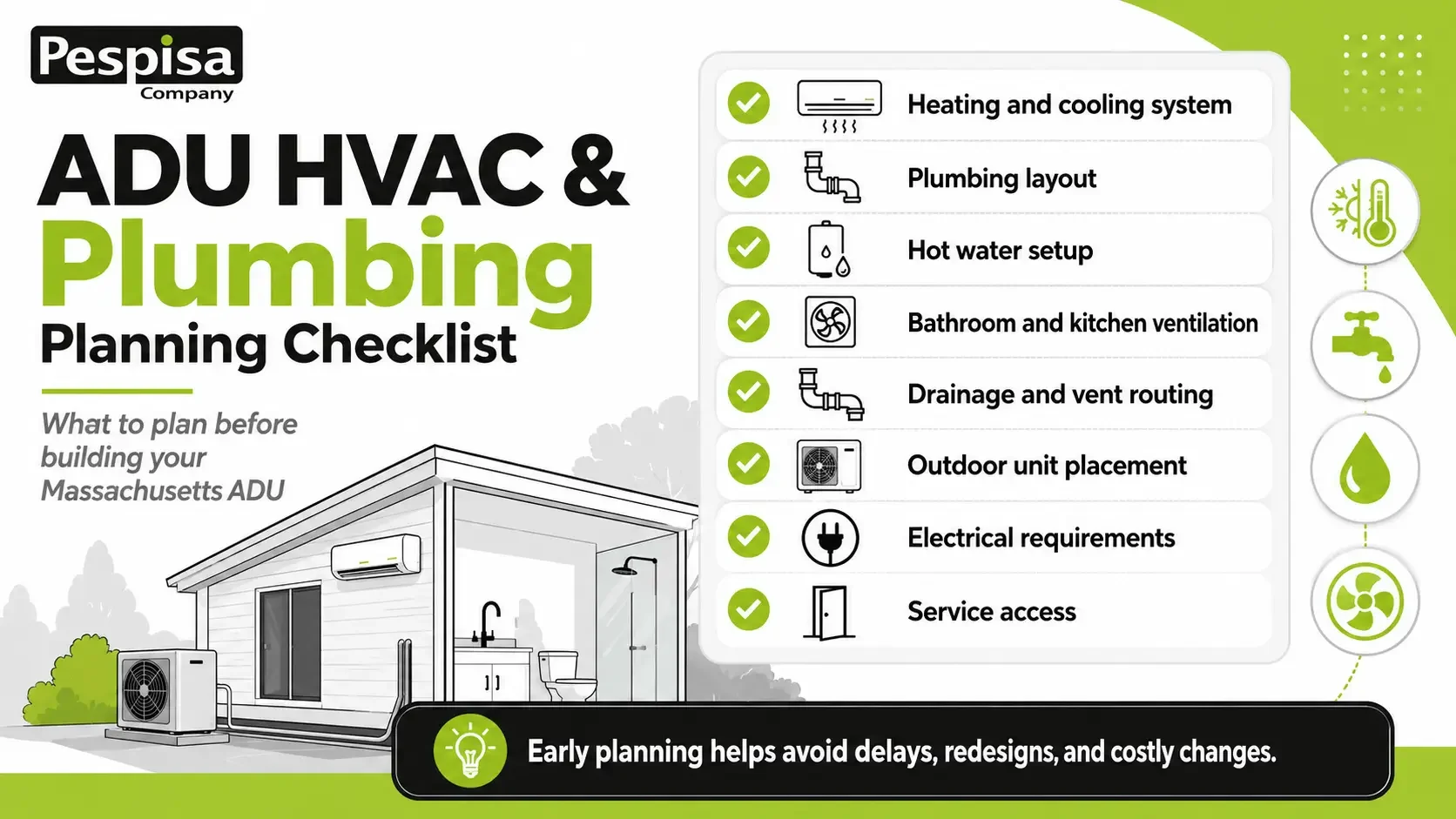
ADUs are usually compact spaces. That means small design choices can have a big impact.
A poorly placed water heater, oversized HVAC system, weak ventilation setup, or difficult drain route can create problems later. In a small living space, there is less room to hide mistakes.
Early HVAC and plumbing planning helps answer important questions before installation begins:
- How will the ADU be heated and cooled?
- Will the system be ductless or ducted?
- Where will the outdoor equipment go?
- How will fresh air and exhaust be handled?
- Where will the water heater be located?
- Can plumbing tie into the main house?
- Will the system be easy to service later?
- Are there code or energy-performance considerations to plan around?
These are not details to leave until the final stage of the project. They should be part of the planning conversation early.
HVAC Options for Massachusetts ADUs
The best HVAC system for an ADU depends on the layout, insulation, square footage, ceiling height, window area, and how the space will be used.
For many Massachusetts ADUs, heat pumps are worth considering because they can provide both heating and cooling. That is useful for small independent living spaces that need comfort throughout the year.
Common HVAC options for ADUs include:
- Cold-climate ductless mini splits
- Ducted mini split systems
- High-efficiency heat pump systems
- Supplemental electric or hydronic heat where appropriate
- Ventilation and filtration solutions for tighter spaces
A ductless system is often useful when the ADU does not have existing ductwork. Pespisa Company offers ductless heat pumps for homeowners who need efficient heating and cooling without traditional ductwork.
For larger ADUs or layouts where hidden air distribution makes more sense, ducted heat pumps may also be an option.
The main goal is not just to pick equipment. The goal is to design a system that fits the space, performs well in Massachusetts weather, and can be maintained over time.
Is a Mini Split for a Garage a Good Option for a Garage Conversion ADU?

A mini split AC for garage projects can be a good option when the garage is being converted into a livable ADU, studio, in-law suite, or finished room. It can provide targeted heating and cooling without requiring traditional ductwork.
That said, a garage conversion in Massachusetts should not be planned around cooling alone. The system also needs to handle cold-weather performance.
Garages often have different construction challenges than the main house. They may have limited insulation, air leaks, concrete floors, lower ceiling clearance, or walls that were never designed for living-space comfort.
Before installing a mini split for a garage conversion, homeowners should think about:
- Insulation and air sealing
- Heating performance during winter
- Cooling needs during summer
- Indoor unit placement
- Outdoor unit placement
- Condensate drainage
- Electrical requirements
- Ventilation and indoor air quality
- Whether plumbing will be added for a bathroom, laundry, or kitchenette
This is why a garage conversion ADU needs a full mechanical plan, not just a quick equipment choice.
A ductless mini split may be the right fit, but it needs to be sized and installed properly. If the system is too small, the space may never feel comfortable. If it is too large, it may cycle poorly and fail to manage comfort well.
For garage conversions, the system design matters as much as the equipment itself. The right ductless heat pump systems can help provide targeted comfort, but placement, insulation, electrical needs, and cold-weather performance all need to be reviewed before installation.
For garage ADUs, HVAC planning should happen before framing, insulation, plumbing, and electrical work are finalized.
Is a Mini Split for a Basement ADU a Good Option?
A mini split for basement spaces can be a good option when the basement is being finished as an ADU, apartment, in-law suite, or independent living area. Basements often need more than basic heating and cooling because moisture, ventilation, ceiling height, insulation, and air movement can all affect comfort.
A ductless mini split for basement ADUs may help provide targeted comfort without extending ductwork into the space. However, the system still needs to be sized correctly. A basement that is partially below grade may have different heating and cooling needs than an above-ground garage conversion or detached ADU.
Before choosing a ductless mini split system for basement use, homeowners should think about:
- Insulation and air sealing
- Humidity control
- Ventilation and fresh air
- Ceiling height
- Indoor unit placement
- Drainage and condensate management
- Bathroom or kitchenette plumbing
- Hot water needs
- Service access
For basement ADUs, HVAC and plumbing planning should happen together. A comfortable space still needs proper airflow, moisture control, reliable hot water, safe drainage, and access for future maintenance.
Plumbing Considerations for ADUs
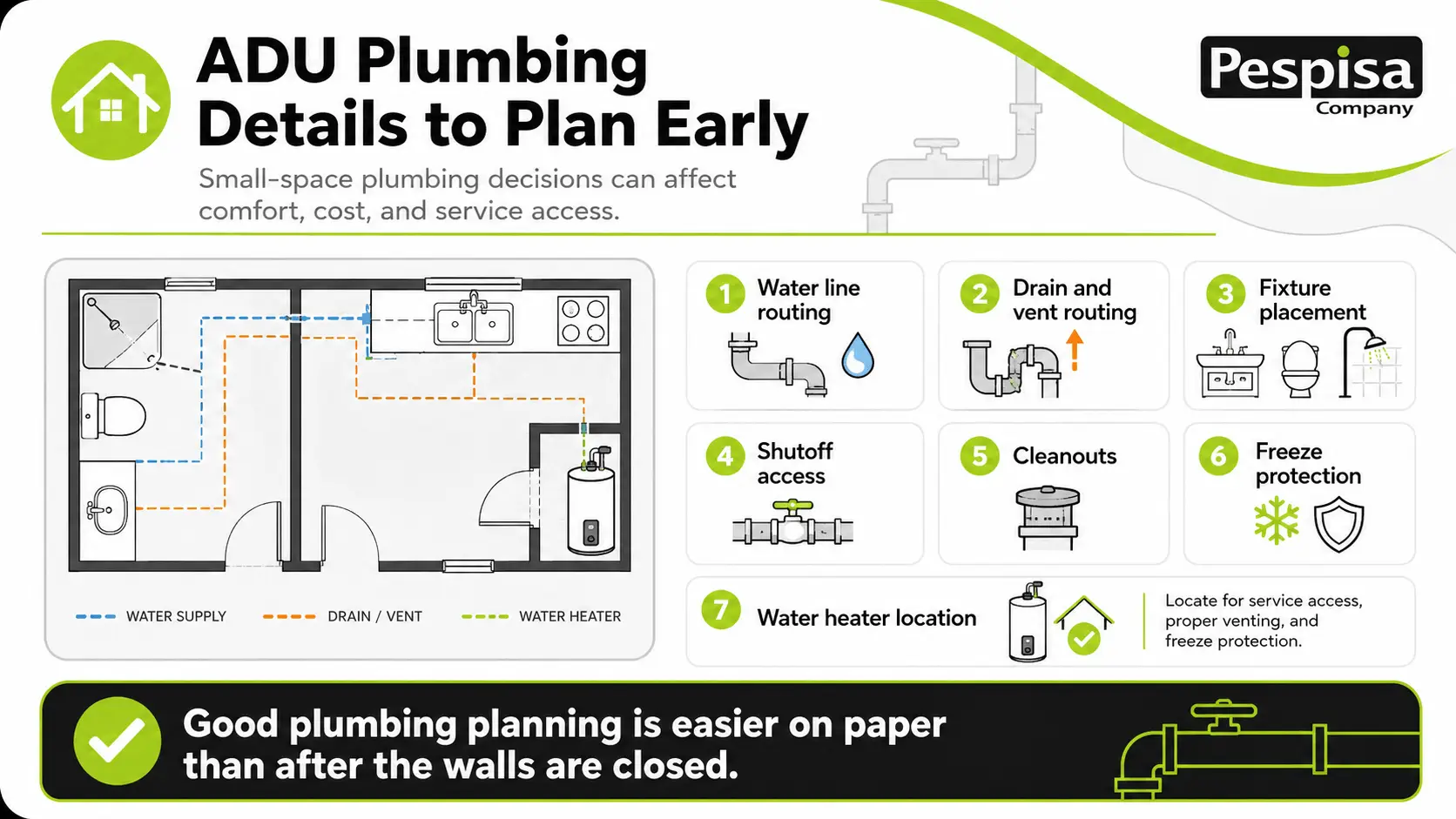
Plumbing an ADU is about more than adding a bathroom and a small kitchen.
The layout needs to support daily use while staying practical for installation and future service. In a small space, poor planning can lead to long hot water wait times, awkward fixture placement, venting issues, or difficult access if repairs are needed later.
Key ADU plumbing considerations include:
- Water line routing
- Drain and vent routing
- Fixture placement
- Shutoff locations
- Cleanout access
- Water heater location
- Freeze protection
- Service access
- Whether to share systems with the main home
- Whether a dedicated plumbing setup makes more sense
Detached ADUs may involve additional planning because water and drain lines may need to run from the main house or connect separately. Basement apartments may involve drainage and venting challenges. Garage conversions may need careful fixture placement because the original space was not built for plumbing.
Pespisa’s plumbing services can help homeowners think through fixture placement, water lines, drains, vents, shutoffs, and service access before the layout is locked in.
Good access also matters after the ADU is complete. Planning around future plumbing repairs can make maintenance easier if a fixture, drain, shutoff, or water line needs attention later.
Hot Water Planning for an ADU
Hot water is one of the easiest ADU details to underestimate.
A small ADU may not need the same system as a full house, but it still needs reliable hot water for showers, sinks, laundry, and kitchen use if those fixtures are included.
Homeowners should think about:
- How many people will use the ADU
- Whether the unit will have a full kitchen or kitchenette
- Whether laundry is included
- Distance between fixtures and the water heater
- Available space for equipment
- Recovery time
- Energy source
- Service access
Some projects may be able to use the main home’s existing water heater. Others may need a dedicated unit. In some cases, a tankless system may be worth considering if space and demand make sense.
Pespisa can help with water heater installation when homeowners need a system that fits the ADU’s space, fixture layout, and expected demand.
In smaller ADUs where space is limited, tankless water heaters may also be worth discussing, depending on demand, fuel source, installation requirements, and available space.
Ventilation, Humidity, and Indoor Air Quality
Ventilation matters in ADUs because many newer or renovated spaces are built tighter than older parts of the home.
Bathrooms, kitchens, laundry areas, and basement spaces all need careful ventilation planning. Without it, an ADU may develop humidity problems, stale air, odors, or comfort issues.
This is especially important for:
- Basement apartments
- Garage conversions
- Detached backyard ADUs
- Small in-law suites
- ADUs with compact bathrooms or kitchens
Good ventilation planning may include bathroom exhaust, kitchen exhaust, fresh air strategies, filtration, and humidity control.
HVAC and ventilation should be considered together. A comfortable ADU is not just warm in winter and cool in summer. It also needs healthy airflow and moisture control.
Energy Code and Performance Considerations
Massachusetts ADU projects may involve energy code and performance requirements that affect heating, cooling, ventilation, insulation, air sealing, and equipment selection.
The exact requirements can vary based on the project, local code path, and how the ADU is classified.
Homeowners and builders may need to think about:
- Energy code requirements
- Stretch code or specialised code considerations
- HERS or ERI pathway coordination
- Blower door testing
- Ventilation compliance
- Insulation and air sealing
- All-electric or mixed-fuel planning
- Heat pump efficiency
This is one reason the HVAC plan should not be treated as an afterthought. Equipment choices can affect comfort, installation, and compliance planning.
Pespisa Company does not just look at the equipment in isolation. The goal is to help homeowners and builders choose mechanical and plumbing systems that make sense for the full project.
Common ADU Planning Mistakes to Avoid
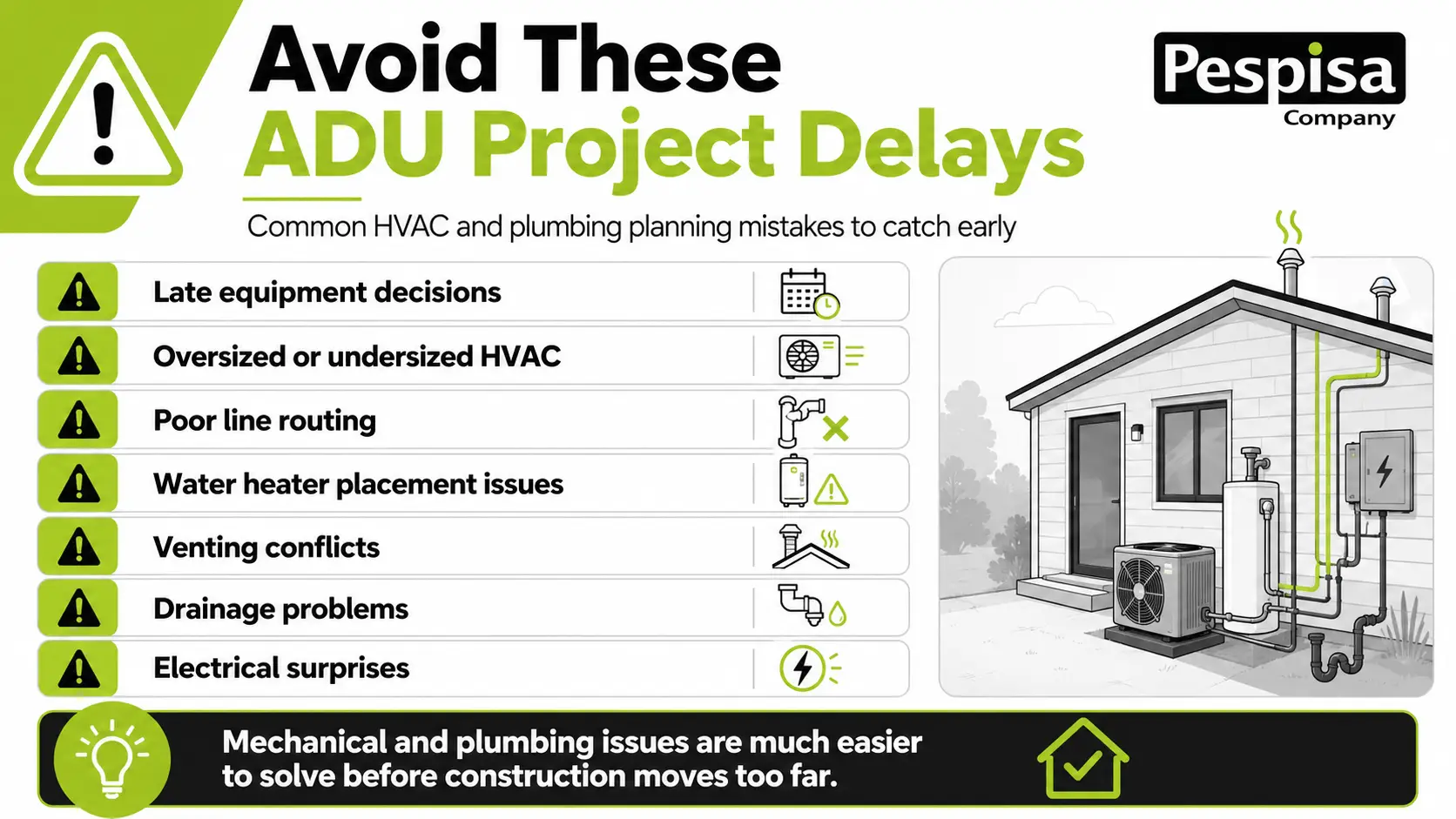
Many ADU problems happen because mechanical and plumbing decisions are made too late.
Common mistakes include:
- Choosing HVAC equipment after the layout is already finalised
- Oversizing or undersizing heating and cooling equipment
- Forgetting about ventilation until late in the project
- Placing the water heater where it is hard to service
- Creating long hot water runs
- Missing drain, vent, or cleanout access needs
- Assuming the main house systems can support the ADU
- Forgetting about condensate drainage
- Underestimating electrical requirements
- Not planning outdoor unit placement early
- Closing walls before routing questions are solved
These issues are easier to solve on paper than in the field.
Once drywall, flooring, cabinets, and finishes are installed, changes become more expensive and more frustrating.
When Should You Bring in an HVAC and Plumbing Contractor?
The best time to bring in an HVAC and plumbing contractor is early in the ADU planning process.
Ideally, this happens before final layout decisions are made and before construction reaches the point where wall, ceiling, plumbing, and equipment locations are hard to change.
Early contractor input can help with:
- HVAC system selection
- Equipment sizing
- Indoor and outdoor unit placement
- Plumbing layout
- Water heater planning
- Drainage and venting
- Ventilation strategy
- Service access
- Heating and cooling performance
- Long-term maintenance
If the ADU is part of a larger renovation, it also helps to coordinate mechanical and plumbing planning with the overall home project.
Pespisa Company provides heating services and plumbing support for homeowners who want to plan practical, efficient systems before installation begins.
Final Thoughts: Plan the ADU Before Problems Become Expensive
HVAC and plumbing planning for ADUs in Massachusetts should happen early. The heating, cooling, ventilation, plumbing, hot water, and equipment layout all affect how comfortable and practical the space will be.
A garage conversion, detached ADU, basement apartment, or in-law suite may look simple on paper, but the hidden mechanical details matter.
If you are planning an ADU in Middlesex County, Pespisa Company can help you think through HVAC, plumbing, hot water, ventilation, and installation requirements before small issues become expensive changes.
To discuss your project, contact Pespisa Company and bring the team in early.
FAQs About HVAC and Plumbing for ADU
What HVAC system is best for an ADU in Massachusetts?
There is no single best system for every ADU. Many Massachusetts ADUs may be a good fit for cold-climate heat pumps, ductless mini splits, or ducted mini split systems. The right choice depends on layout, insulation, room size, ventilation needs, and how the space will be used.
Is a mini split AC for a garage a good choice for a garage conversion ADU?
Yes, a mini split AC for a garage can be a good option if the garage is being converted into a livable space. In Massachusetts, it is important to choose a system that can handle both cooling and cold-weather heating.
Can an ADU use the main house plumbing?
Sometimes, but not always. It depends on the existing plumbing system, fixture layout, distance, drain and vent routing, water heater capacity, and local project requirements. In some cases, a dedicated setup may make more sense.
Does an ADU need its own water heater?
Not always. Some ADUs may be able to use the main home’s water heater, while others may need a dedicated system. The best option depends on hot water demand, fixture distance, available space, and installation requirements.
When should HVAC and plumbing be planned for an ADU?
HVAC and plumbing should be planned as early as possible, ideally before final layout decisions are made. Early planning helps prevent routing problems, equipment placement issues, ventilation conflicts, hot water delays, and costly field changes.